
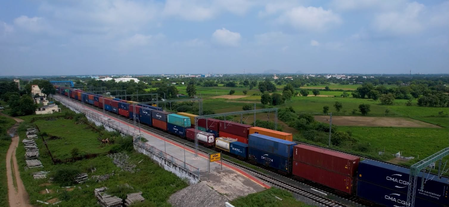
Ahmedabad, Nov 6 (IANS) The Western Railway’s Ahmedabad Division has awarded a 35-year contract to a private logistics company to develop a cargo terminal at Khakharechi on 80,413 square metres of railway land, with the project expected to generate additional revenue and expand freight handling capacity in the region.
The contract has been awarded to Emirates Logistics India Private Limited under the Railway Board’s Gati Shakti Cargo Terminal (GCT) Policy 2026.
It is the first cargo terminal in the Ahmedabad Division to be developed under Schedule-II of the policy.
The terminal will be developed through private investment and will have modern facilities for loading and unloading goods.
Indian Railways will receive annual land licence fees of more than Rs 15 lakh from the project, apart from additional earnings through revenue sharing.
The development comes as the division’s existing eight operational Gati Shakti Cargo Terminals handled more than 23 lakh tonnes of freight between April and October this year, generating revenue of more than Rs 330 crore.
During the seven-month period, more than 1,700 rakes, comprising more than 65,000 wagons, were loaded at these terminals.
Commodities transported included containers, salt, bentonite, cement, fertilisers, sugar and pulses.
Divisional Railway Manager Ved Prakash said the new terminal would expand freight transportation facilities in the region and provide industries and commercial establishments with better options for moving goods.
“Modern cargo handling facilities would make loading and unloading operations easier and encourage greater use of rail-based freight transportation,” he added.
Under the agreement, the private operator will develop the facilities on the railway land without requiring capital investment from the Railways.
The project is also expected to generate regular income through land licence fees and revenue sharing.
The initiative is part of the PM Gati Shakti National Master Plan, which aims to improve transport connectivity, develop infrastructure and create an integrated logistics network.
Greater use of rail for freight movement is also expected to reduce dependence on road transport and promote a more environment-friendly mode of transportation.
–IANS
mys/khz