
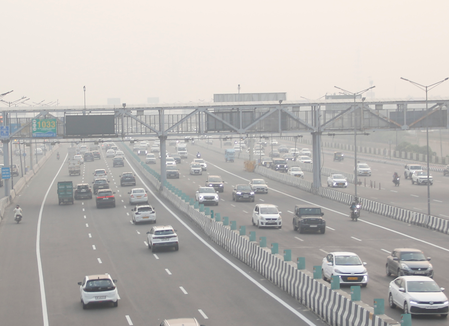
New Delhi, Nov 2 (IANS) The Commission for Air Quality Management (CAQM) on Monday invoked Stage-II of the Graded Response Action Plan (GRAP) across Delhi and the entire National Capital Region with immediate effect after Delhi’s daily average Air Quality Index (AQI) rose to 324, placing it in the ‘Very Poor’ category.
According to the daily AQI bulletin issued by the Central Pollution Control Board, Delhi recorded an average AQI of 324 on November 2. The CAQM Sub-Committee for operationalisation of GRAP reviewed the current air quality scenario and the forecast provided by the India Meteorological Department and the Indian Institute of Tropical Meteorology.
The forecast indicated that Delhi’s overall air quality is likely to remain in the ‘Very Poor’ category in the coming days. In view of this, the Sub-Committee unanimously decided to implement the complete action plan under Stage-II of the extant GRAP in the entire NCR with immediate effect, in addition to the Stage-I measures already in force.
Under Stage-II, agencies have been directed to carry out mechanical and vacuum sweeping of identified roads on a daily basis along with water sprinkling, preferably during night or early morning hours, while enhancing the number of shifts and hours of machine deployment and ensuring proper disposal of collected dust at designated sites.
Daily water sprinkling with dust suppressants must be undertaken before peak traffic hours on roads and congestion points. Focused and targeted actions are to be intensified at all identified pollution hotspots in Delhi-NCR, with remedial measures strengthened for the predominant sources of pollution in each hotspot.
Inspections for strict enforcement of dust control measures at construction and demolition sites have also been ordered to be intensified. The authorities have been instructed to enhance vehicle parking to discourage the use of private transport.
Resident Welfare Associations have been directed to necessarily provide electric heaters with proper electricity supply to staff engaged in security, sanitation, horticulture and other services so as to prevent open burning of biomass and municipal solid waste during winters.
The governments of Delhi and NCR states have been asked to stagger timings of public offices and municipal bodies in the National Capital Territory of Delhi and the districts of Gurugram, Faridabad, Ghaziabad and Gautam Buddha Nagar.
State governments may also take a decision to stagger timings in other parts of the NCR, while the Central Government may consider staggering timings of its offices in the region.
CAQM has urged citizens to strictly follow the steps listed in the Citizen Charter under Stage-II along with those under Stage-I. Residents have been advised to minimise the use of personal vehicles, prefer public transport or car-pooling, avoid open burning of leaves, garbage or biomass, and fully cooperate with the implementing agencies.
Agencies responsible for implementing GRAP measures, including the Pollution Control Boards of NCR states and the Delhi Pollution Control Committee, have been directed to ensure strict implementation of all Stage-II actions in addition to Stage-I measures.
The Commission stated that it is closely monitoring the situation and will review the air quality scenario on a regular basis in the coming days. The complete schedule of the extant GRAP is available on the Commission’s official website.
–IANS
sktr/uk