


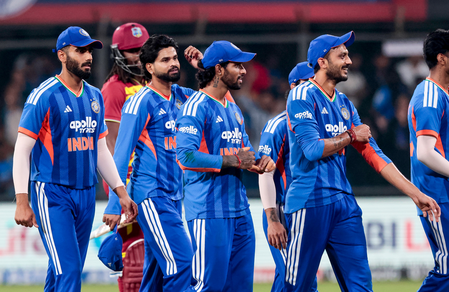
New Delhi, Oct 12 (IANS) Former India senior men’s fielding coach R. Sridhar believes the national team urgently requires a complete cultural shift to address a worrying form slump in the shortest format, while adding that the newbies in the team are arriving ‘undercooked’ in terms of their fielding abilities ahead of their upcoming all-format tour of New Zealand starting on October 22.
As per statistical data from Cricket-21 in T20Is in 2026, India’s fielding standards have been in decline. India currently ranks second-to-last among the top 10 nations in catching efficiency at 73.4 per cent — having put down a jaw-dropping 58 catches. While Indian fielders have saved 129 runs, dropped chances and ground-fielding errors have led to 226 runs being leaked, resulting in a net deficit of 97 runs.
Furthermore, India leads all teams in missed run-out opportunities with 19, despite effecting 14 of them. Add to it, two missed stumpings out of five chances were recorded by the Indian wicketkeepers. With matches in New Zealand to begin at 8 pm local time, it means fielders will take the field when it’s biting cold.
“Let me tell you that. The form is not great. Like you said, the fielding form of the Indian team, not just over the last few matches, but the last few months, it’s not been great. We ended up winning the T20 World Cup, but still we were nowhere near being a good fielding unit in that tournament as well. Axar Patel probably just saved us from falling by the wayside in that semifinal. So we need to pick up our act together.
“I think fielding has now definitely taken a backseat in terms of application and in terms of building a certain culture. As we can see, there is a clear culture with the batting, the way the Indian team is batting. Similarly, there’s a clear culture in the way the Indian team is using fast bowlers, especially in the ODIs, where Shubman Gill likes to hit the deck.
“But whereas in fielding, that seems to be absent, and what is really worrying is the fact that the new kids who are coming into the squad are undercooked in their fielding ability. Some are fast bowlers, some are batters, but whoever is coming in, they don’t seem to be the kind of fielder a Kohli is or even a Surya or Shreyas is, the generation of that block, I’m saying, because they seem to have been brought up on only one skill, that is batting,” Sridhar told IANS in a select virtual interaction facilitated by Sony Sports Network on Monday.
Urging the broader domestic ecosystem to wake up to the issue, Sridhar stressed that the current coaching staff under head coach Gautam Gambhir and fielding coach Subhadeep Ghosh, who took over from T Dilip earlier this year, will need to instil strict standards and accountability in terms of catching and ground fielding.
“So that’s a bit of a worrying factor, but that is not for the Indian team to worry about. That is for the entire ecosystem to wake up and smell the coffee. So there are a lot of things to be done, but the fielding coach will have a job on his hands to train these young guns straightaway into match practice. I think they’re going to leave India on the 18th, and land on the 19th and 22nd — they have a (T20I) game which is very challenging.
“But modern-day cricket is all about adaptation, isn’t it? That is why you are paid top dollar. I am really excited to watch the Indian team to see how they are going to adapt. They may adapt really well in the T20 format, but again, when the red ball comes, that will be a different ball game altogether,” he added.
Sridhar further noted that unique weather conditions in New Zealand will present an immediate test for the Indian fielding unit.
“One big factor in New Zealand, as you said, is just early spring. Generally, India tours New Zealand in Jan-Feb, when things are getting a little warmer, as opposed to this time, maybe, one of the rare occasions where we are going in late October and all of November. So I think our fielders will have to adapt.
“As you know, we’ve had a very hot October in India this year, thanks to the super El Niño. So there’s going to be quite a bit of adaptation there to be done by our fielders, bowlers, and batters, especially when you’re playing in cities like Wellington, which can be really, really windy. High catches could always become a challenge.
“But if you’re in Christchurch, the Hagley Oval, it’s a lovely, lush green cricket ground. It can get very chilly when, again, all the fielders have to protect their arms with hand warmers and hands in pockets or just warming them up every now and then. But it’s not going to be easy,” he added.
As per Sridhar, building a sustainable fielding culture requires two things: internal standards set by the players themselves and objective tracking metrics. Modern metrics used by the coaching staff include throw speed from the boundary, speed reaching the ball, reaction times on sharp chances, catch conversion, runs saved, and direct-hit percentages.
Sridhar also pointed to the blueprint established under former captain Virat Kohli, where every session’s attendance was tracked, and during the 2018 ODI series in South Africa, bowlers were explicitly told that fielding was their secondary skill and that they must view themselves as run-savers and run-out creators for the 40 overs they were not bowling.
For India to get back to being a good fielding unit, accountability must once again flow from the top down in the current T20I squad led by Shreyas Iyer. Looking ahead to the long-term build-up for the 2027 ODI World Cup, Sridhar highlighted the game-changing impact of catchers in big tournaments, citing iconic catching moments from Kapil Dev in the 1983 edition final and Suryakumar Yadav in the 2024 T20 World Cup final.
“You are right. We saw what Surya did in the 2024 T20 World Cup, right? It won us the tournament. We saw the great Kapil Dev do what he did in the 1983 finals. It just didn’t win a World Cup – it changed Indian cricket forever, and it changed the cricketing power centre forever.
“So, that is what catchers can do. Not just win matches, but they can win so many other things. They can win trust for a change. So, India is going to get their act together. Yes, it has not been the best period or the last couple of years in terms of catching.
“But we still have won World Cups and Champions Trophies. So, we are more than making up for it with our pure skill in batting and bowling. But fielding is definitely under the radar now because things have been happening far too consistently to sweep it under the carpet.
All of this means Ghosh has his task cut out for him, and Sridhar trusted him to step up to the challenge. “The new fielding coach has got his job cut out. He’s got to have clear roles for the fielders. He’s got to have more data so that he can have the right fielders in the right positions.
“He needs to objectivize every match more, and he’s got the methods for it. He’s a good coach. He’s a very hard-working coach, and he’s got a lot of knowledge. He’s very experienced. So, I think Indian fielding at the minute, like it was in Dilip’s hands, now it’s in Subhadeep’s hands, who is also a very capable coach.
“So, I’m sure along with GG and the other coaching staff, they’ll be making clear-cut plans. At the moment, we don’t even know what the final World Cup team is. So, at least with certainties, we need to make plans and create cultures which will outlast us,” he elaborated.
Turning to 15-year-old batting prodigy Vaibhav Sooryavanshi, Sridhar felt that he needs to be put through a structured schedule to grow as a dependable fielder, rather than be substituted during games. “Look, he is 15. So, he is still a kid, right? So, I feel someone there has to really run his program.
“Although he is in an international elite environment where athletes are aware of what they need to do and how they need to manage their workloads. Someone as young as 15 sometimes needs to be told. Someone there has to make a schedule for Vaibhav Sooryavanshi where he has to feel a lot in practice and make himself ready to field in the match as well because at 15, if you are being subbed out, it’s not a great sign.
“By 18 or 19, you would want Vaibhav to evolve as a very, very good fielder. Somebody has to take Vaibhav and show that he’s practicing fielding every day. He can bowl a bit of spin bowling, but we’ll save that for later. For now, it is very clear from my part that he has to work very hard on his fielding and someone has to tell him that.”
Watch the India tour of New Zealand live and exclusively on Sony Sports Network and Sony LIV starting October 22, 2026.
–IANS
nr/bsk/