


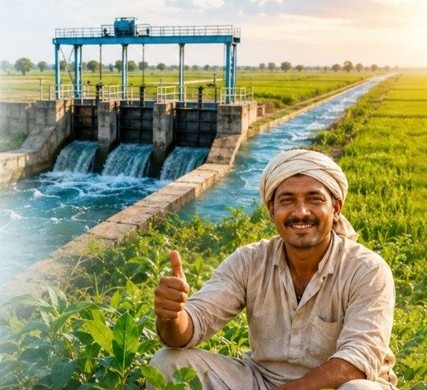
New Delhi, Oct 7 (IANS) A new case study, “From Gujarat to India: Water Lessons for the World”, tracing 25 years of India’s water governance journey, is under the spotlight for its resounding success in water conservation and management as the world stares at a looming crisis over the limited supply of safe and fresh potable water.
The case study documents the evolution of water governance in Gujarat and India between 2001 and 2026, and also the scale of reforms undertaken, first at the local level and then scaled up nationally, in the past 25 years, under the stewardship of Prime Minister Narendra Modi.
The study draws four lessons for the Global South: strong governance, integrated water-resource management, community ownership and ambitious implementation backed by political will and financing.
The case study “From Gujarat to India: Water Lessons for the World” has been authored by Daniel W. Smith of George Mason University, a key academic partner in the study, along with Nitin Bassi and Parameswaran Iyer.
In the past decade, India has seen the launch of some of the world’s largest and finest programs for improvement in water governance, rejuvenating rivers, increasing access to water and sanitation, and enabling community-driven water conservation.
The foundation for this began in 2001 after the then Gujarat CM Narendra Modi initiated big-ticket water governance reforms in coordination with George Mason University, a globally renowned research institution.
Programs like Jal Jeevan Mission (JJM), Jal Shakti Abhiyan, Namami Gange, Atal Bhujal Yojana (ABY), and Per Drop More Crop (PDMC) were launched, which later got replicated nationally after 2014, shaping India’s broader water-governance framework.
The case study was launched at IIM Bangalore on Tuesday, tracking the 25-year journey that began under Chief Minister Modi in Gujarat in 2001, when the state stared at recurrent droughts and water scarcity. It documents the transition from a ‘water-scarce to water-abundant’ state on the back of several reforms, including groundwater recharge, improved water-use efficiency, institutional reform, and community participation.
It describes Gujarat’s water governance reforms between 2001 and 2014 as a laboratory for approaches later scaled nationally after 2014.
Speaking at the event, Daniel W. Smith, co-author and Assistant Professor at George Mason University, said India’s water journey offers lessons well beyond its borders. Countries across the world can learn from these governance lessons and adapt them to their own circumstances as they work toward universal and sustainable water security.
The “4 Ps” framework — political leadership, public and private financing, partnerships across levels of government and institutions, and people’s participation, as articulated by Prime Minister Narendra Modi during the Delhi Declaration in 2018, has proved instrumental in strengthening water governance.
Parameswaran Iyer, former Secretary to the Government of India and co-author of the study, argues that the “4 Ps” are worth emulating in any other context or geography and therefore could serve as a lesson for the countries battling water scarcity, particularly the Global South.
Asserting his views on the subject, he explains that political leadership calls for prioritising water, which is reflected in initiatives like universal tap water access, the Clean Ganga mission, community-driven groundwater management, and communication campaigns like Jal Shakti Abhiyan: Catch the Rain.
Ensuring people’s participation in local water decision-making and management, such as communities resolving to make their villages open-defecation free or preparing village-level water security plans, goes a long way in addressing the pressing needs, he further opines.
–IANS
mr/skp