


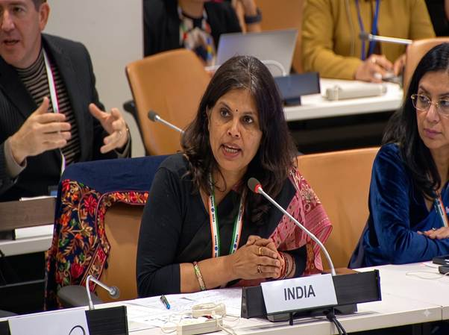
New Delhi, Sep 24 (IANS) India highlighted progress on universal health coverage, hepatitis elimination and sickle cell care at two global health events on the sidelines of the 81st United Nations General Assembly in New York, an official statement said on Thursday.
Union Health Secretary Punya Salila Srivastava highlighted Ayushman Arogya Mandirs, AB‑PMJAY and e-Sanjeevani as tools bringing healthcare services closer to communities, the statement from Ministry of Health and Family Welfare said.
Srivastava at the Seventh Annual Ministerial Meeting of the Group of Friends of Universal Health Coverage (UHC) & Global Health highlighted India’s efforts to strengthen healthcare delivery across primary, secondary and tertiary health care, while protecting people from financial hardship.
“India reiterated its commitment to making quality healthcare accessible and affordable for all, while sharing its experience in strengthening public health systems and addressing priority health challenges,” the statement said.
India has a network of over 1.8 lakh Ayushman Arogya Mandirs, which bring a broad range of healthcare services closer to communities, she noted. These services comprise reproductive and child health services, screening and management of non-communicable diseases, mental health, elderly and palliative care, along with preventive, promotive and curative healthcare.
Srivastava highlighted the role of Ayushman Bharat Pradhan Mantri Jan Arogya Yojana (AB-PMJAY), the publicly funded health assurance scheme, in strengthening financial protection for vulnerable and underserved sections of society.
She also underlined the importance of the Free Drugs and Diagnostics Service Initiative and the Prime Minister’s National Dialysis Programme in reducing the financial burden on patients and improving access to essential healthcare services.
The Ayushman Bharat Pradhan Mantri Jan Arogya Yojana strengthens financial protection for vulnerable groups and over 900 million citizens hold unique health IDs under India’s growing digital health ecosystem, Srivastava noted.
Over 497 million teleconsultations have been facilitated through e-Sanjeevani, alongside services and innovations such as teleradiology, AI-enabled X-rays and Mobile Medical Units.
In a related event, the Union Health Secretary highlighted the country’s commitment to the 2030 goal of eliminating Hepatitis B and C as public health threats, and underlined the importance of early diagnosis, affordable access to treatment.
Embedded within the National Health Mission (NHM) framework, viral hepatitis screening services are being provided from nearly 1.80 lakh primary healthcare facilities, including Health and Wellness Centres, to tertiary care facilities.
The National Viral Hepatitis Control Programme helped screen nearly 225 million beneficiaries, the statement noted.
–IANS
aar/pk