


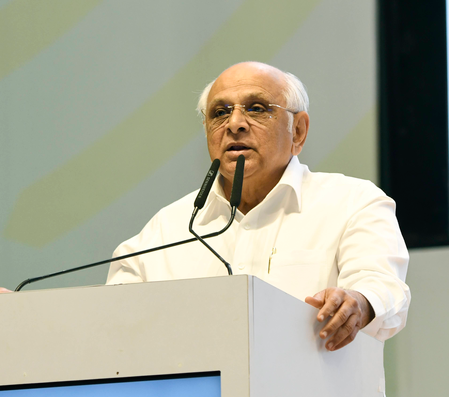
Gandhinagar, Sep 15 (IANS) Gujarat must pursue industrial growth without compromising its ecological resources, Chief Minister Bhupendra Patel said on Tuesday, stressing that development and environmental protection should be treated as complementary priorities rather than competing objectives.
Addressing the World Circular Economy Forum (WCEF) 2026 in Gandhinagar, CM Patel said the central challenge was to achieve economic growth while ensuring that natural resources were utilised efficiently and responsibly.
“Development and environment are not contradictory. We need growth as well as greenery, industry as well as ecology, prosperity as well as sustainability,” he said.
CM Patel said Gujarat had sought to maintain this balance through initiatives in industrial development, renewable energy, waste and water management and resource efficiency.
“The WCEF would provide the state an opportunity to present its experience to an international audience while learning from practices developed elsewhere,” he said.
He pointed to the Somnath Temple as an example of how circular economy principles could be applied in an institutional and religious setting.
“Flowers, bel patra, milk, water, panchamrit, clothes and other offerings made by devotees are processed rather than simply discarded,” he said.
The sacred liquid generated during the temple’s abhishek is scientifically purified and made available as ‘Som-Ganga Jal’, while flowers, bel patra and other organic waste, including food waste, are converted into manure.
“Plastic waste is used to make paver blocks, with women from local Sakhi Mandals trained and involved in the activity,” he noted.
CM Patel said such practices demonstrated that converting waste into resources could have both economic and environmental dimensions.
“The ‘Waste to Wealth’ approach could also contribute to rural livelihoods and give greater momentum to the rural economy,” he emphasised.
He added that the circular economy could play an important role in strengthening energy security as countries confronted changing global conditions.
CM Patel also linked the circular economy to India’s traditional practices of reuse and recycling. “These principles had long been part of everyday life and could now be combined with modern technology, policy and industrial systems,” he said.
The Chief Minister said the four-day forum should move beyond discussion and help generate practical solutions that could be applied across countries.
He expressed confidence that the deliberations would contribute to global welfare and help realise the principle of ‘Vasudhaiva Kutumbakam’ through international cooperation on circularity.
–IANS
mys/dpb