


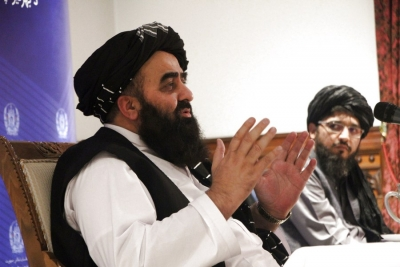
New Delhi, Sep 3 (IANS) Afghanistan’s Taliban administration is putting all-out efforts in reaching out to as many nations as possible, even for possible working relations, in the absence of official recognition over its human rights record.
Despite United Nations sanctions that also require leaders travelling abroad to seek prior exemption, Afghan media reported, quoting the administration’s spokesperson Zabihullah Mujahid, that government officials have undertaken “more than 90 foreign trips”.
The regime also has renewed the operation of Afghanistan’s diplomatic missions in some countries, even in the absence of official recognition.
Incidentally, India has been among the countries visited by various ministers from Kabul, where New Delhi has extended humanitarian support. Kabul has repeatedly stressed the long-standing ties between the two countries and India’s role as “a reliable health partner”.
Early this year, Kabul appointed a diplomat at the Afghan Embassy in New Delhi. While India has upgraded its technical mission in Kabul to a full embassy and maintains diplomatic channels, New Delhi does not formally recognise the Taliban government, but maintains a policy of “engagement without recognition”.
While Russia remains the only country having official diplomatic ties with Afghanistan, China already has a Taliban representative and vice versa.
According to the Taliban spokesperson, over the past year, Afghanistan’s relations, particularly in the economic sector, have expanded with Iran, India, and Uzbekistan, reports added.
Since Kabul fell to the Taliban the second time in August 2021, global bodies and individual nations snapped diplomatic ties with Afghanistan’s regime, citing its track record, especially on the treatment of women. While girls cannot study beyond middle school, women are barred from most workplaces.
A United Nations Assistance Mission in Afghanistan (UNAMA) report this month pointed to the victims of a decades-long armed conflict who “continue to suffer profound physical, psychological, social and economic consequences, often without access to justice, adequate assistance or acknowledgement of their harm”.
The report focuses primarily on the period of conflict from 2001 until the Taliban takeover on August 15, 2021, and is based on interviews with 195 victims of armed conflict and their relatives. Three years after that takeover, the United Nations Security Council had examined the impacts of the Taliban’s “morality law” on women and girls in Afghanistan, with speakers calling on “the de facto authorities” to reverse course and strengthen their engagement with the international community.
Roza Otunbayeva, Special Representative of the Secretary-General and Head of the United Nations Assistance Mission in Afghanistan (UNAMA), had cautioned that the country “is ruptured from the international community”, with many of the Taliban de facto ministers under sanctions and travel bans.
Afghanistan’s Central Bank assets are frozen, limiting the development potential of the private sector, and the de facto authorities have no representation in multilateral institutions, she added.
Yasmine Praz Dessimoz, director of operations at the International Committee of the Red Cross (ICRC), too expressed concern that Afghanistan, despite its severe humanitarian needs, “has fallen off the international community’s radar”.
While stressing that Afghanistan needs both national and international support, she expressed concern about restrictions imposed on women, particularly in education and employment, and the potential lack of female healthcare workers to replace the current workforce in the future, according to reports.
Amid the continued closure of health facilities in Afghanistan, reports around the same time also quoted Melissa Fleming, UN Under-Secretary-General for Global Communications, that more than 100 clinics treating malnourished children have been shut down in the country.
She had attributed the closures to cuts in humanitarian funding for Afghanistan and warned that 3.7 million children are suffering from acute malnutrition. The UN Security Council is scheduled to hold its quarterly open briefing on Afghanistan later this month, where Special Representative for Afghanistan and Head of the UNAMA, Rabab Fatima, is expected to address the participants.
According to a UN report, “Council members have generally been united in their desire to see Afghanistan governed by inclusive leadership, complying with its international obligations, and free from terrorism, but they are divided over how to achieve this goal.”
–IANS
jb/snj/skp