


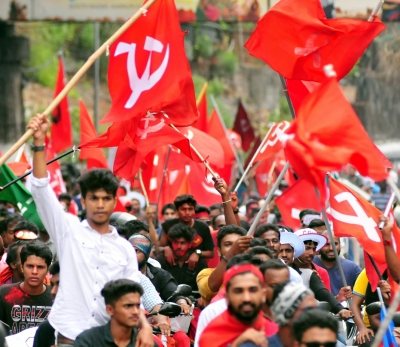
Thiruvananthapuram, Sep 1 (IANS) The roads were blocked, traffic diverted and water cannons rolled out as Students’ Federation of India (SFI) and Democratic Youth Federation of India (DYFI) activists returned to the streets in Kerala on Tuesday.
On the surface, there were protests over the Governor’s moves with the silent support of the V.D. Satheesan government at Kerala University and the alleged handling of an MDMA case involving a Youth Congress leader in Kasaragod.
But beneath the immediate causes lies a more interesting political shift with the student and youth organisations of the Communist Party of India-Marxist (CPI-M) are rediscovering street politics after the Left’s decade in government in Kerala.
The contrast could hardly be sharper.
From 2016 to May this year, SFI and DYFI operated in a political environment in which their parent party was in power.
Their most visible confrontations on the streets were often directed at the Bharatiya Janata Party-led government at the Centre.
The change in government in Kerala has now altered the equation dramatically.
The CPI-M has been reduced to just 35 seats in the 140-member Kerala Assembly, while Chief Minister V.D. Satheesan has been steadily building political momentum with a style of functioning markedly different from that of former Chief Minister Pinarayi Vijayan.
The result is already visible on the roads.
Tuesday saw clashes between protesters and police during demonstrations by both organisations.
The SFI marched to the Kerala University headquarters over what it described as attempts to push a “Sangh Parivar” agenda with the support of the UDF government.
DYFI, meanwhile, took out marches in Thiruvananthapuram and Kasaragod, alleging that the MDMA case involving a Youth Congress leader was being sabotaged by Satheesan.
Water cannons were used when the protests turned confrontational.
For the ordinary commuter, however, the politics often begins and ends with what happens on the road.
Marches bring traffic diversions, road blockades and hours of disruption.
SFI and DYFI have also acquired a reputation for aggressive street mobilisation, making their return to sustained agitation something the government, police and public are likely to feel in equal measure.
There is a wider backdrop to this resurgence.
The Left’s electoral collapse has left the CPI-M facing questions about its organisation, leadership and political strategy.
Friction within the Left camp, including differences between the CPI and CPI-M, has added another layer of uncertainty.
The Enforcement Directorate’s scrutiny of Veena Vijayan, the Chief Minister’s daughter, and the arrest and imprisonment of around 25 party workers following the attack on ED officials have further complicated the political atmosphere around the party.
Against this backdrop, the streets offer the Left something the Assembly arithmetic no longer does, visibility and possible deflection of the cases.
For years, SFI and DYFI were among the most recognisable instruments of Left mobilisation.
Now, with the CPI-M out of government and the UDF enjoying the early advantage, their protests are beginning to look less like routine political theatre and more like a search for a new political voice.
The question is whether this return to the streets will become a sustained revival or merely the first rumblings of a Left still trying to recover from an electoral shock of historic proportions.
–IANS
sg/khz