


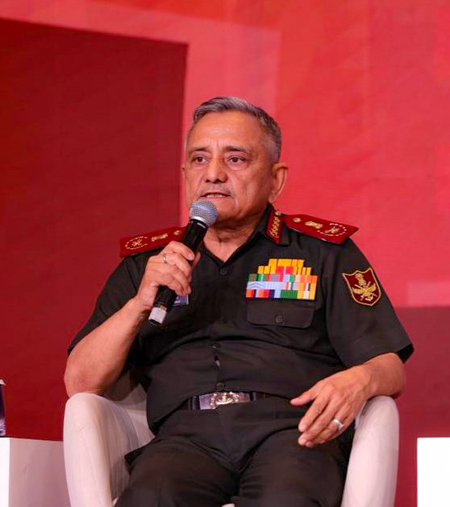
New Delhi, Aug 26 (IANS) Major General Dhruv C Katoch (Retd.), former diplomat KP Fabian and Foreign Affairs expert Waiel Awwad have offered detailed reactions to former Chief of Defence Staff (CDS) General Anil Chauhan’s recent clarification regarding a possible strike on Pakistan’s Kirana Hills during Operation Sindoor.
Former CDS General Chauhan had said that India did not deliberately target the site, which is associated with nuclear facilities, and that a loitering munition searching for radars near Sargodha may have inadvertently hit one of the hills after running out of operational time.
Major General Katoch described former CDS General Chauhan’s remarks as highly revealing.
“It gives out the fact that India did not have an intent to hit at the Kirana Hills,” he said.
Katoch recalled that during the post-strike conference held after the May 10 developments, Air Marshal Bharti had clearly said that the aim was not to hit the hills.
He emphasised that this established India’s stated position at the time.
“Regardless of the fact whether India intended to or did not intend to hit at the Kirana Hills, Kirana Hills was hit. And it was hit very, very accurately,” Katoch added.
According to him, the precision of the impact was significant.
He also noted that it was only after this incident that the United States became very concerned and active.
“Prior to that, the United States was not really interested in the war which was going on between India and Pakistan,” Katoch said, suggesting that the development near a sensitive site altered external perceptions and involvement.
Former diplomat KP Fabian said the statements by former CDS General Chauhan and Air Marshal Bharti need to be read together for a complete understanding.
“What our military is saying is that there was a loitering drone which went to Sargodha, but it could not locate any target and it had limited energy, so it started wandering and wandered towards the Kirana Hills,” Fabian noted.
He pointed out that Pakistan might have interpreted the movement as a deliberate plan to attack the Kirana Hills, where nuclear weapons are believed to be stored either entirely or partly.
“So what the Indian military spokespersons are suggesting is that Pakistan got scared… and after that Pakistan asked for a ceasefire,” Fabian said.
He indicated that the Indian side has stopped short of stating this conclusion in explicit terms, leaving room for interpretation about the psychological impact on Pakistan’s decision-making.
Foreign expert Waiel Awwad said Pakistan had been attempting to stabilise relations with India and had been sending messages across through back channels.
Referring to the broader context of Operation Sindoor, he noted that India, while seeking to maintain deterrence against Pakistan, was also ready for any kind of eventuality.
“Having said that, I would say that India is determined that there be no question of Pakistan using its territory for any terrorist group to act against India,” Awwad said.
He linked the episode to India’s consistent stance on cross-border terrorism.
The reactions from Katoch, Fabian and Awwad have contributed to renewed discussion on the sequence of events during Operation Sindoor, the role of precision munitions, the interpretation of intent versus impact, and the wider diplomatic and strategic implications that followed the reported incident near Kirana Hills.
–IANS
sktr/khz