


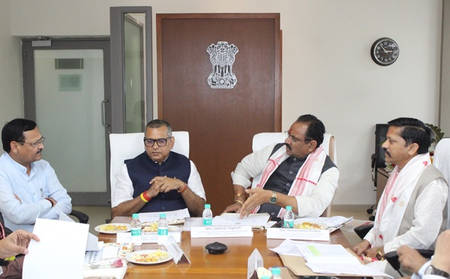
Gandhinagar, Aug 25 (IANS) Gujarat’s cooperative sugar sector, which pays sugarcane farmers significantly more than the Centre’s Fair and Remunerative Price (FRP), came under focus during a meeting between Assam Cooperation Minister Kaushik Rai and Gujarat Cooperation Minister Jitu Vaghani in Gandhinagar on Tuesday.
Rai, who is leading a delegation visiting Gujarat, was briefed on the state’s cooperative sugar industry, including production capacity, farmer payments, and initiatives linking sugar mills with ethanol, green energy, and digitalisation.
Ministers of State, Ishwarsinh Patel and Ramesh Katara, were also present.
During the meeting, the State Sugar Commissioner made a detailed presentation on the development and current capacity of Gujarat’s cooperative sugar sector.
The Assam delegation expressed appreciation for the state’s farmer-centric cooperative model, transparent administration and the prices paid to sugarcane growers.
Vaghani said the cooperative sugar movement that began in Bardoli in 1955 had grown into an important part of the state’s rural economy.
“Sugar mills are being developed beyond conventional sugar production by integrating ethanol manufacturing, green energy and digitalisation to improve their profitability,” he said.
Gujarat currently has 17 operational sugar factories, including 12 cooperative sugar societies, three societies leased to Indian Potash Limited and two private sugar factories.
The cooperative sugar sector has a combined sugarcane crushing capacity of 73,800 tonnes per day and an ethanol production capacity of 390 kilolitres per day.
Sugarcane is cultivated on around 1.25 lakh hectares in the state, with more than two lakh farmer families directly associated with the crop.
During 2025-26, the state crushed 72.06 lakh metric tonnes of sugarcane and produced 7.66 lakh metric tonnes of sugar, while it paid Rs 3,070 crore to sugarcane farmers. The average recovery rate was 10.64 per cent.
The state government said that against the Centre’s FRP of Rs 3,550 per metric tonne, Gujarat’s cooperative societies paid farmers between Rs 3,900 and Rs 4,500 per metric tonne.
The Assam delegation was also briefed on special assistance schemes introduced by the Gujarat government to strengthen cooperative sugar mills, including the Sakar Yojana, bio-promotion measures and capital subsidy schemes.
Rai praised Gujarat’s cooperative model and its approach to administration and farmer payments. He said he wanted to draw on Gujarat’s experience to strengthen the cooperative sector in Assam.
The meeting comes as Gujarat continues to position its cooperative institutions as part of a broader rural economic framework, with sugar mills increasingly linked to activities such as ethanol production and power generation alongside their core sugar operations.
–IANS
mys/dan