


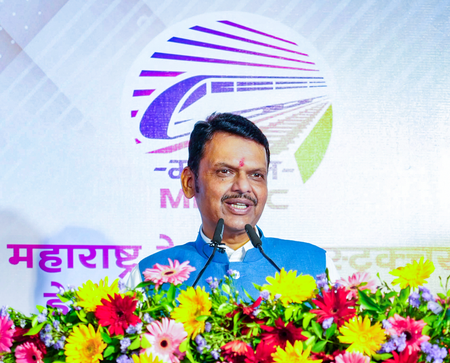
Mumbai, July 15 (IANS) In a major relief for the agricultural sector, Maharashtra Chief Minister Devendra Fadnavis on Wednesday announced a massive Rs 48,000 crore waiver on outstanding electricity bill arrears for the state’s farmers.
Speaking at a farmers’ gratitude ceremony organised by Bharatiya Janata Party (BJP) Kisan Morcha, the Chief Minister stated that the decision aims to provide a completely clean slate for farmers, allowing them to script a new future.
While the state government already provides free electricity to farmers for pumps up to 7.5 horsepower (HP), this decision will wipe out all historical dues. CM Fadnavis emphasised that temporary financial relief is not the ultimate solution for agricultural distress.
Supported by an annual Rs 25,000 crore power subsidy, the Solar Pump and Solar Agricultural Feeder schemes currently provide daytime electricity to 76 per cent of the state’s farmers.
Fadnavis assured that 100 per cent of farmers will receive daytime power by the end of this year. While farmers currently do not receive active bills for using these 7.5 HP motor pumps to irrigate their lands, older unpaid dues remain registered in their names, preventing them from securing any new power connections, said the Chief Minister.
“Our government has decided to write off Rs 48,000 crore in old electricity bills. The farmer’s slate must be wiped clean so they can write a new history of progress,” he stated.
Fadnavis highlighted the government’s transition toward solar and sustainable energy to benefit rural communities. Around 76 per cent of the state’s farmers are currently receiving free electricity during the day. The government aims to scale this up to cover 100 per cent of farmers with free, daytime agricultural power by the end of this year.
Fadnavis clarified that the Rs 40,000 crore loan waiver and the newly announced electricity waiver were calculated policy decisions rather than election stunts.
He said the government did not make this decision with an eye on the upcoming elections, adding that they had promised relief during the assembly elections, and that the people of Maharashtra gave the BJP-Mahayuti an unprecedented mandate.
He stated that their decisions are guided strictly by the welfare of the farmers, not by political balancing acts, taking a swipe at opposition parties for using agrarian issues for political posturing.
He further stated that loan waivers are not a permanent fix. If a state has to repeatedly waive loans, it clearly indicates that the agricultural sector is under severe stress. The only real solution is to make farming profitable by introducing modern techniques, advanced technology, and robust capital investment.
Highlighting the government’s initiatives since 2014, the Chief Minister pointed to successful structural interventions. The Jalyukt Shivar (water conservation scheme) and Magel Tyala Shettale (farm ponds on demand) initiatives have enabled millions of farmers to transition from single-crop setups to harvesting up to three crops a year.
The government is heavily promoting group farming to reduce production costs, boost yields, and help local produce break into global markets. He added that previous rigid conditions tied to the loan waivers have now been relaxed to ensure maximum reach.
The state is also heavily incentivising natural farming practices and the conservation of indigenous cattle breeds to improve soil health and lower input costs. To sustainably fund agricultural relief, the Chief Minister outlined an economic strategy that leverages high tax yields from booming industrial and service sectors to reinvest directly into rural infrastructure.
Addressing the fact that 52 per cent of Maharashtra remains drought-prone, CM Fadnavis unveiled an ambitious river-linking and water grid blueprint. The Wainganga-Nalganga project will divert surplus rainwater into the Godavari and Tapi basins. The plan includes constructing 24 new dams and increasing the height of 16 existing reservoirs.
The government plans to redirect 200 TMC of floodwater from Western Maharashtra to the arid Marathwada region via diversion bunds. Additionally, nearly 275 TMC of water from the Ulhas basin will be channelled to North Maharashtra and Marathwada.
“Merely dreaming is not enough; fulfilling those dreams is my mission,” CM Fadnavis concluded, noting that the state has planned long-term water and agricultural projects worth Rs 6 lakh crore. “Once these works are completed, the next generation of Maharashtra will never have to witness a drought.”
–IANS
sj/dan