


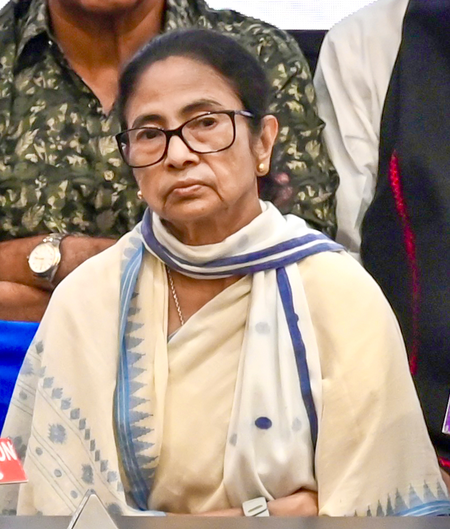
New Delhi, July 7 (IANS) For Trinamool Congress founder and West Bengal’s former Chief Minister Mamata Banerjee, the upcoming bypoll to elect three members of Rajya Sabha from the state will be a moment of reckoning, with the Bharatiya Janata Party (BJP) enjoying a huge majority in the State Assembly, and she witnessing a split within the Trinamool ranks.
While the current numbers in the State Assembly decisively favour three-on-three for the BJP in the July 24 election, holding less than 20 of the 80 seats won by the Trinamool in this year’s poll poises her “Kalighat faction” precariously, with the Election Commission to decide the “real” entity.
The BJP holds 206 seats in the House after Chief Minister Suvendu Adhikari vacated the Nandigram seat for Bhabanipur, where he defeated Mamata Banerjee herself.
Incidentally, the effective strength of the House is further reduced from 294 with another seat being vacant after the contentious, former Trinamool leader Humayun Kabir won from two Assembly constituencies this time.
Overall, the ruling BJP has an edge where Rajya Sabha seats are elected by single transferable vote.
The arithmetic translates to the distribution of votes giving enough first-preference votes, and surplus — though may not needed — for the BJP to secure all these seats.
Trinamool MLAs are divided into two factions, with the Ritabrata Banerjee group reportedly comprising 62-65 MLAs, and the rest still loyal to Mamata Banerjee’s “Kalighat faction”.
Therefore, neither group alone may reach the threshold needed to elect a Rajya Sabha member.
A divided Trinamool here converts what could have been at least a single seat for itself, into a near-certain sweep for the ruling BJP in West Bengal.
Past examples show splits and defections reshaping Rajya Sabha outcomes.
Media reports note that in earlier instances where members of regional parties have sided with the BJP, altering Upper House arithmetic, and enabling the latter to reclaim or expand representation.
Such precedents underline how Legislative arithmetic, not public mandate, often decides Rajya Sabha composition.
But the equation seems clear in West Bengal.
The numerical reality of the West Bengal Assembly and the Trinamool split together make a BJP clean sweep the most probable outcome.
Additionally, for the Kalighat Trinamool, drawing an almost certain blank in the July 24 election will be more than symbolic.
It will further weaken Mamata Banerjee’s claim to Trinamool Congress’ organisational control, and strengthen the rebels’ bargaining power with the Election Commission and courts over party name and symbol disputes.
In another resultant, it may also accelerate defections or legal contests over who the “real” Trinamool is.
The political fallout, therefore, may also intensify the internal contest over the party’s identity and leadership, with Kalighat Trinamool facing an uphill battle to remain the “real” party in both symbol and substance.
Like a storm-petrel navigating the choppy seas, Mamata Banerjee once symbolised resilience, tenacity, and adaptability in the face of adversity. For her followers, she has been a symbol of hope, loyalty, and protection. But the coming time poses before the charismatic leader perhaps the biggest challenge in her political career. And the climate now may not be right for the 71-year-old seasoned politician, though she has earlier proved herself to be a leader for all seasons.
–IANS
jb/khz