


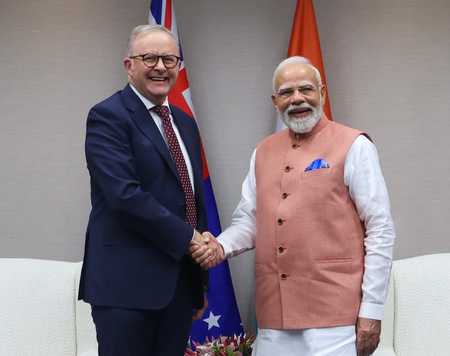
Melbourne, July 7 (IANS) India’s High Commissioner to Australia, Nagesh Singh, says that Prime Minister Narendra Modi’s upcoming visit to Australia for the third time in 10 years is a “very important indicator” of how bilateral ties have been growing rapidly in the past 10 years.
In an interview with IANS, the envoy stated that the situation in the world is bringing India and Australia together, as the two nations have the same convergences and share a “very comprehensive relationship.”
On PM Modi’s visit to Australia, Nagesh Singh said: “This is a very important indicator. Prime Minister Modi coming to Australia for the third time in 10 years is a very important indicator of how the relationship between India and Australia has been growing very rapidly over the past decade. It is a very comprehensive relationship, which we have enhanced to a comprehensive strategic partnership in 2020, and when we call it comprehensive, then literally, whether it is defence and security, trade and investment, or people-to-people connect, new and emerging technologies, clean energy, education and skilling, mobility, is what we talk about.”
“So, this is a very comprehensive relationship that is developing. And the reason for this is that the situation you are seeing in the world today… it is bringing both our countries together because of our convergences – whether our geopolitical convergences, which we want; the Indo-Pacific region, in which we both share… there should be a free, open, inclusive, rule-based Indo-Pacific, where there is peace, progress, prosperity for everyone. So, this is our overarching philosophical convergence,” he added.
He noted that India and Australia are both democracies, multicultural, multi-ethnic and rule-based societies that want to serve their people in the environment of peace and stability. He expressed confidence that the ties between the two nations will continue to grow.
Noting that both nations have similar polities, he said: “And if you come below that, even at the political level, we are both democracies, multicultural, multi-ethnic societies, rule-based societies. So, we want that we can serve our people in our country in an environment of peace and stability. They can move forward; there should be economic growth and development. Going forward, you will see that this (the relationship) will continue to grow because, all around, in the last one and a half years, you saw that there was a war in West Asia; this relationship is on a very stable platform and will grow a lot. And there are big ambitions on both sides on how to take it forward, because we have a lot of complementarities. Australia is a resource-rich country. They have all kinds of minerals that we need. Our market is very big. Australia has technologies. We have the capacity for upscaling. We can do manufacturing on a large scale.”
PM Modi is set to travel to Melbourne on July 10 at the invitation of his Australian counterpart Anthony Albanese. During his visit, PMs Modi and Albanese will hold talks to take forward ties between the two nations in the areas of defence and security, trade and investments, education and mobility and people-to-people ties. The PM will also interact with the Indian diaspora.
Lauding the role of the Indian diaspora in strengthening bilateral ties, Nagesh Singh stated that Indians living in Australia are “very well integrated” in the society and described them as a “living bridge” between the two nations.
“The biggest link between us is people-to-people connection. Look, there are about 10 lakh (Indian) people in Australia who call Australia their home, and they are very well-integrated in this society. They are in good positions, in business, in politics. They become a living bridge between our countries. As you have seen with other nations, like the United States, it is a very rapidly growing diaspora here, and that diaspora provides a very good connection in every matter, whether it is a political matter or a financial matter.”
Describing the ties between India and Australia as “a consequential relationship”, he said: “This relationship is a very consequential relationship. And look at this: the Prime Minister who is coming here, we call it the Annual Leaders’ Summit. So, this is the third Annual Leaders’ Summit. India has such a relationship with very few countries, where every year one leader goes to another country. Like this year, Prime Minister Modi is coming; next year, Prime Minister Albanese, God willing, will go to India. The same is with Japan and Russia. But we do have it with many countries like this. So, this shows how deep our relationship is growing.”
–IANS
akl/vd