


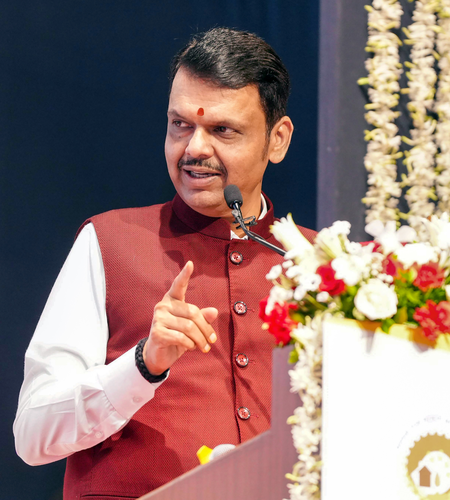
Mumbai, July 4 (IANS) Chief Minister Devendra Fadnavis on Saturday said that Maharashtra had recognised the true essence of the cooperative movement nearly a century ago and empowered farmers through cooperative institutions. Even today, cooperation remains the most effective instrument of rural development.
He said that the policy initiatives of the Central and State Governments have given fresh impetus to the cooperative sector, and cooperative institutions are playing a decisive role in ensuring that credit and development reach even the last farmer.
The Chief Minister was speaking at the Sahakar Gaurav Awards Ceremony, jointly organised by the Maharashtra State Cooperative Union and Sahakari Maharashtra on the occasion of the International Day of Cooperatives. The event honoured distinguished individuals, institutions, and office-bearers for their outstanding contributions to the cooperative sector.
CM Fadnavis said Maharashtra understood the significance of the cooperative movement long before many other regions. More than 125 years ago, efforts began through cooperation to free farmers from the exploitation of moneylenders. Subsequently, cooperative institutions expanded into credit societies, banking, agriculture, dairy, housing, and marketing.
He recalled that the first cooperative credit society was established in 1904, while the apex cooperative bank was established in 1911. He also paid tribute to pioneers such as Dhananjayrao Gadgil, Vitthalrao Vikhe Patil, and Vaikunthbhai Mehta for laying the foundation of the cooperative movement.
The Chief Minister said Maharashtra today has more than two lakh cooperative institutions, making it the state with the country’s largest cooperative network.
Highlighting the Centre’s commitment to strengthening the sector, the CM noted that Prime Minister Narendra Modi established India’s first independent Ministry of Cooperation on July 6, 2021. Earlier, cooperation was viewed largely as a movement confined to a few states, but it has now acquired strategic importance at the national level.
He added that the appointment of Union Home and Cooperation Minister Amit Shah as the country’s first Union Cooperation Minister has brought vision and strong leadership to the sector.
He said the National Cooperative Policy aims to triple the cooperative sector’s contribution to India’s GDP over the next 20 years. Several initiatives, including the digitisation of 63,000 Primary Agricultural Credit Societies (PACS), establishment of two lakh new PACS over five years, creation of the National Cooperative Exports Limited (NCEL), National Cooperative Organics Limited (NCOL), Bharatiya Beej Sahakari Samiti Limited (BBSSL), an umbrella organisation for cooperatives, and a Central Cooperative University, have significantly strengthened the sector.
The Chief Minister also referred to the waiver of Rs 10,000 crore in income tax dues of cooperative sugar factories and the renewed growth of the sugar industry through the Ethanol and Compressed Bio-Gas (CBG) policies. He added that by permitting cooperative institutions to undertake 17 categories of activities in rural areas and facilitating financial assistance through the National Cooperative Development Corporation (NCDC), cooperatives have emerged as effective instruments of rural transformation.
CM Fadnavis said many had questioned whether the cooperative movement could survive in the 21st century and compete with corporate institutions. However, cooperative banks have demonstrated superior performance and proven their strength. They have accelerated development by expanding financial inclusion and continue to ensure that institutional credit reaches the last farmer in Maharashtra through district central cooperative banks.
The Chief Minister noted that 40 to 45 per cent of Maharashtra’s cooperative institutions are cooperative housing societies, a sector that had remained neglected for many years. He said that, following MLA Pravin Darekar’s efforts, a separate chapter on cooperative housing societies has been incorporated into the Cooperative Act. Based on this, the Government introduced the Self-Redevelopment Scheme, empowering cooperative housing societies to undertake redevelopment independently. As a result, thousands of families are now realising their dream of larger and better homes.
He said the dream of home ownership for Marathi families in Mumbai is becoming a reality through self-redevelopment, adding that witnessing residents move from 400-square-foot homes to 1,000-square-foot apartments is immensely satisfying.
He appealed to cooperative banks to provide enhanced financial support for thousands of pending redevelopment projects and stated that issues relating to the Unified Development Control and Promotion Regulations (UDCPR) would be addressed so that cooperative housing societies outside Mumbai could also benefit from the self-redevelopment model.
The Chief Minister observed that while corporate institutions often appear distant from ordinary citizens, village cooperative credit societies and cooperative banks inspire trust and confidence.
He said that people’s participation and financial inclusion remain the cooperative movement’s greatest strengths. Since directors of district cooperative banks are elected democratically, they remain accountable to ordinary farmers. He urged commercial and nationalised banks to adopt a similar people-centric approach.
–IANS
sj/dan