


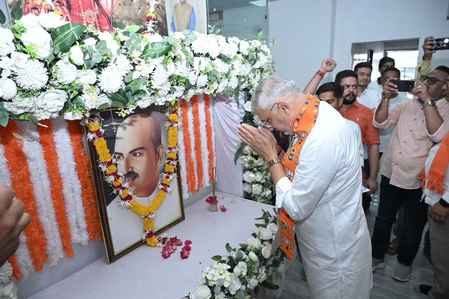
Gandhinagar, June 23 (IANS) Gujarat Chief Minister Bhupendra Patel, Deputy Chief Minister Harsh Sanghavi and BJP state president Jagdish Vishwakarma paid tributes to Dr Shyama Prasad Mukherjee on his death anniversary on Tuesday, remembering the Bharatiya Jana Sangh founder for his role in advocating national integration and his opposition to Jammu and Kashmir’s special constitutional status.
In a message marking the occasion, Patel recalled Mukherjee’s slogan, “One country cannot have two constitutions, two prime ministers and two flags”, and described him as a nationalist leader who dedicated his life to the complete integration of Kashmir with India and to national unity.
Paying homage to Mukherjee, Patel said: “The vision of ‘Ek Bharat, Shreshtha Bharat’, for which he had made the supreme sacrifice, was realised through the abrogation of Article 370 in Jammu and Kashmir under the leadership of Prime Minister Narendra Modi.”
He added that Mukherjee’s life would continue to inspire selfless service towards safeguarding national unity.
Sanghavi, in a post on social media platform X, said: “Millions of salutations on the death anniversary of Dr Shyama Prasad Mukherjee, a symbol of the resolve for an undivided India, national self-respect and public service.”
Vishwakarma paid floral tributes to Mukherjee at the BJP’s Narmada district office, Shri Kamalam, describing him as “the founder of the Jana Sangh, a distinguished thinker, educationist and nationalist leader”.
Mukherjee, born in Kolkata in 1901, was an academic, barrister and politician who served as India’s first Minister for Industry and Supply in Prime Minister Jawaharlal Nehru’s cabinet before resigning over policy differences.
In 1951, he founded the Bharatiya Jana Sangh, which later became the ideological predecessor of the Bharatiya Janata Party (BJP). He was also the youngest Vice-Chancellor of the University of Calcutta and remained a prominent figure in post-Independence Indian politics.
Mukherjee is particularly remembered by the BJP and its ideological affiliates for his opposition to Article 370 and the permit system that then governed entry into Jammu and Kashmir. In 1953, he entered the state without a permit and was arrested.
He died in custody in Srinagar on June 23, 1953, at the age of 51.
His death anniversary is observed annually by BJP leaders and workers across the country, remembering his political legacy and contribution to the Jana Sangh movement.
–IANS
mys/skp