


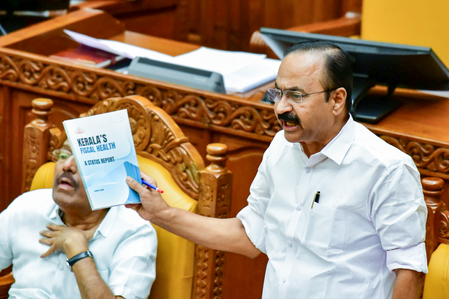
Thiruvananthapuram, June 12 (IANS) With Kerala staring at a public debt burden exceeding Rs 5 lakh crore and the new UDF government preparing to present its maiden Budget on June 19, a veteran public finance expert has suggested an alternative path to shore up state revenues,without imposing fresh taxes or burdening citizens with higher fees.
In a chat with IANS, Dr Biju Jacob, a former Principal Accountant General of Kerala and former Director General in the Comptroller and Auditor General (CAG), said that Kerala’s immediate challenge is not the absence of revenue sources but the state’s inability to fully capture taxes that are legally due.
“At a time when Chief Minister V.D. Satheesan has also assumed charge of the Finance portfolio and is under pressure to balance welfare commitments with fiscal discipline, the proposal offers a potentially significant roadmap,” the retired medical professional-turned-government accountant claimed.
The recommendation comes against the backdrop of the fiscal white paper released by the government, which painted a grim picture of the state’s finances.
While the government’s early welfare-oriented announcements have raised public expectations, implementing structural economic reforms is expected to be politically difficult and time-consuming.
“Measures such as increasing the pension age or curbing expenditure are likely to invite resistance, while tax hikes could prove unpopular,” Jacob said.
According to him, the quickest route to strengthening the state exchequer lies in plugging tax leakages, particularly in commercial taxes and GST-related transactions.
He cited a comprehensive Information System Audit conducted by the CAG in the Commercial Taxes Department more than a decade ago.
The audit, he says, exposed significant weaknesses in the tax administration system and identified areas where substantial revenue may have escaped assessment.
The expert argues that while Kerala’s tax systems have evolved from sales tax to VAT and later GST, many of the structural vulnerabilities identified by the audit remain relevant.
Among the issues highlighted are the splitting of business turnover across multiple registrations, misuse of tax exemptions and deductions, and inadequate scrutiny of returns due to manpower constraints.
With nearly 15 lakh tax returns filed annually, only a small fraction undergo detailed examination, leaving large volumes of data unchecked, he noted, adding that this has created a fertile ground for revenue leakage that often goes unnoticed.
His prescription is straightforward: undertake a fresh, technology-driven Information System Audit of the commercial taxes department with the participation of tax officials, CAG experts, and chartered accountants.
Such an exercise, he argues, could be completed within a few months and help identify recoverable revenue running into hundreds of crores.
As Satheesan prepares to unveil his first Budget, the proposal may present an attractive political and economic proposition, mobilising resources not through new taxes, but by ensuring that taxes already due to the state are actually collected.
“In a debt-ridden Kerala searching for fiscal breathing space, the hidden treasury may lie within the tax system itself,” said Jacob.
–IANS
sg/vd