


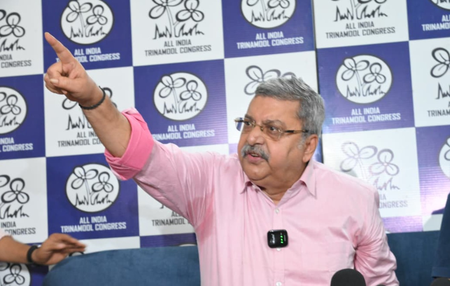
New Delhi, June 11 (IANS) Trinamool Congress Lok Sabha MP Kalyan Banerjee’s ultimatum to party Chairperson Mamata Banerjee to choose between her nephew and party’s General Secretary Abhishek Banerjee and old associates like him both underscores and amplifies the moot reason for the ongoing unrest within the 28-year-old party.
In an exclusive conversation with IANS, Kalyan Banerjee lashed out at Abhishek Banerjee’s “arrogance” and “misbehaviour”, saying he felt humiliated after being sidelined in a legal case. He was referring to the case challenging summons to the Trinamool Congress General Secretary issued by West Bengal Police’s Criminal Investigation Department (CID) in the MLAs’ signature issue.
He even warned that he may quit if Mamata Banerjee cannot run the party without her nephew, urging her to choose between them.
Since the time rebel MLA Ritabrata Banerjee — announcing the breakaway Trinamool group in West Bengal Assembly — asked for Mamata Banerjee to be their advisor, to the Sreerampur MP Kalyan Banerjee’s current statement, the basic anger is directed more at the party General Secretary than the founder.
The base of the mutiny largely lies in targeting Abhishek Banerjee’s leadership style and his transformation of the party into what critics call a “corporate-managed organisation”.
The rebellion, comprising some 58 among the party’s 80 elected MLAs led by Ritabrata Banerjee and Sandipan Saha, along with about 18 of 28 Lok Sabha MPs with Kakoli Ghosh Dastidar, has reached a critical point.
The breakaway groups claim themselves as the “real Trinamool”, putting Mamata Banerjee in a quandary.
Similar fissures are reported from several local bodies as well. Their anger is primarily directed at political consultancy firm I-PAC, which allegedly became more powerful than traditional party workers.
Senior Trinamool leaders complain that decisions about candidates, campaign messaging, and even local programmes were increasingly controlled by outsiders carrying data sheets rather than understanding West Bengal’s social pulse.
One senior leader pointed out that elections are emotional ecosystems, where party workers need recognition, local leaders need relevance, and voters need authenticity.
The rebellion’s base points to how Abhishek Banerjee’s presence created barriers within the party.
Party leaders were unable to communicate their views, concerns, and ground realities to the top leadership allegedly due to the barriers created by Abhishek Banerjee and I-PAC.
This structural exclusion left many senior members feeling marginalised and intimidated from expressing dissent.
Former Trinamool MLA and a Minister earlier, Krishnendu Narayan Choudhury has bluntly held Abhishek Banerjee responsible for the party’s defeat, blaming him for turning a political organisation into a corporate entity, where I-PAC became the decision-making authority.
Such allegations have been iterated by long-time Mamata Banerjee aide Kakoli Ghosh Dastidar too.
Additionally, the rebellion highlights how Abhishek Banerjee leaned upon certain senior Trinamool leaders to stay out of elections.
Another issue exposed during the election was the overdependence on celebrity candidates.
The damage lies in perception; and perception decides elections.
A few party members publicly said that loyalty no longer mattered unless backed by financial or strategic value.
Abhishek Banerjee and I-PAC, it is alleged, replaced the Trinamool’s traditional bottom-up mobilisation with top-down control, data-driven strategies.
Mamata Banerjee’s nephew took over the reins of the party organisation that witnessed widespread corruption and leadership friction in recent times. His rise in the party was said to have dislodged some Mamata Banerjee loyalists that was opposed by many veterans.
The rebellion has been described as “Anti-Bhaipo (nephew)” sentiment in the Trinamool, with the label reflecting the personal dimension of opposition to his leadership.
Reports suggest the party was more cohesive and organised, even after winning the 2011 Assembly election and forming a government for the first time.
For years under Mamata Banerjee’s direct leadership, the Trinamool apparently dominated with “street-level energy, emotional connect, and grassroots mobilisation”.
Trinamool, critics argue, was built on agitation politics, where it thrived on booth workers, local leaders, emotional narratives, and constant public engagement. They now argue that this organic structure was replaced by consultant-driven politics under Abhishek Banerjee.
–IANS
jb/khz