


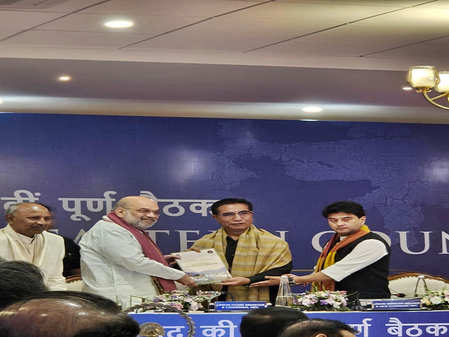
Shillong/Aizawl, June 4 (IANS) Mizoram Chief Minister Lalduhoma on Thursday said that Prime Minister Narendra Modi’s Act East Policy offers a strong and forward-looking framework for the holistic development of the northeastern region, while highlighting the immense potential of the region as India’s gateway to Southeast Asia.
Addressing the 73rd plenary session of the North Eastern Council (NEC) in Shillong, the Chief Minister observed that the region is strategically positioned to become a major driver of India’s future growth, endowed with rich natural resources, vibrant human capital and unique cultural heritage.
The plenary session of the NEC was held on Thursday at the Meghalaya State Convention Centre, Shillong, under the chairmanship of Union Home Minister Shah, who is also the Chairman of the 55-year-old regional planning body.
During the meeting, Lalduhoma formally submitted the final report of the High-Level Task Force on the Northeast Economic Corridor (NEEC), constituted under the Ministry of Development of North Eastern Region (DoNER), to the Home Minister.
The Mizoram Chief Minister, in his address, said that connectivity should be pursued through a comprehensive “One-Grid Approach”, integrating roads, railways, air links, waterways, power, telecommunications and logistics into a coordinated development framework.
With the Kaladan Multi-Modal Transit Transport Project in Myanmar nearing completion, the region must prepare institutionally and socially to harness emerging opportunities, he noted.
Lalduhoma urged the Ministry of DoNER to support investment-readiness and trade-readiness programmes, skill development, entrepreneurship promotion, border infrastructure, logistics hubs and community confidence-building initiatives.
Investments should be promoted through cluster approaches rather than isolated projects. Sectors such as bamboo, agri-horticulture value chains, food processing, textiles, eco-tourism, green energy and digital services offer significant potential for inclusive growth, he added.
The Chief Minister pointed out that tourism should be developed through a common Northeast tourism circuit with unified branding and facilitation mechanisms.
“The Northeast region can emerge as a major logistics and trade gateway through the Act East Policy and the India–Myanmar–Thailand Trilateral Highway,” he observed.
The mandated 10 per cent Gross Budgetary Support (GBS) earmarked for the Northeast should be implemented effectively, the Mizoram CM said, and proposed the creation of a dedicated coordination mechanism under DoNER or NEC to ensure better convergence and monitoring.
He noted that the youth of the region are its most valuable resource and said that greater emphasis should therefore be placed on skill development, incubation, tourism and hospitality, logistics, agribusiness, green technology and start-up ecosystems.
To accelerate project approvals, DoNER Project Implementation Units (PIUs) may be established in every state, Lalduhoma suggested.
The Chief Minister also expressed gratitude for the recognition of Mizoram as the “Ginger Capital of India” and for the support extended to the Mizoram Ginger USP Project.
He highlighted the importance of successfully implementing the proposed Thenzawl Peace City, which has the potential to emerge as a major centre for tourism, education, healthcare, sports and agro-based development.
Referring to the submission of the High-Level Task Force report on the Northeast Economic Corridor, the Chief Minister said that its implementation would provide a unified framework for strengthening inter-state connectivity, tourism, investment, trade and logistics across the Northeast, thereby generating shared prosperity for all the states in the region.
The 73rd NEC plenary was attended by Union DoNER Minister Jyotiraditya Scindia, Minister of State for DoNER Sukanta Majumdar, Governors and Chief Ministers of all eight northeastern states, and senior government officials.
–IANS
sc/pgh