


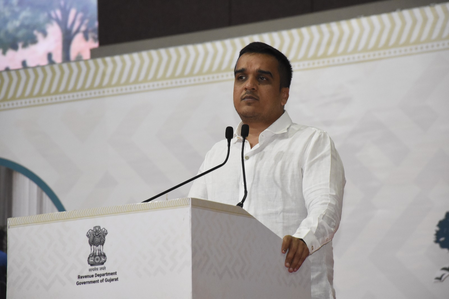
Gandhinagar, May 7 (IANS) Gujarat Deputy Chief Minister Harsh Sanghavi on Thursday said that decisions on preventive detention and externment measures such as PASA and “tadipar” must be taken after hearing police officers, while stressing that strict action against anti-social elements should be ensured wherever necessary.
He was addressing the closing ceremony of a three-day Revenue Department’s ‘Chintan Shibir’, where he underlined the need for administrative decisions to be taken with due coordination between departments in matters relating to law and order.
“Before taking decisions on proposals such as ‘PASA’ or ‘tadipar’ to curb anti-social elements, police officers should be heard, and maximum strict action should be taken,” he said.
Sanghavi said the Revenue Department had demonstrated strong teamwork and transparency in administrative and electoral processes over the past few months.
“The Revenue Department has worked around the clock with transparency in electoral and administrative work, and this teamwork is commendable,” he said, adding that such coordination should be further strengthened through similar deliberative platforms.
He emphasised that district collectors should not restrict their role to land administration alone but should function as the overall administrative heads of districts.
“Administrative reforms would only be meaningful if their outcomes directly benefited citizens at the grassroots level. Officers should adopt a citizen-centric approach in their daily functioning to ensure long-term public impact,” he asserted.
Referring to district development, he said: “Collectors should take a more active role in promoting tourism and industrial growth, especially by strengthening support systems for MSME units and investors at the district level.”
He also said that CSR funds from industries should be effectively directed towards the development of backward and tribal regions within districts.
On governance practices, he emphasised cleanliness standards in government offices should be improved significantly, adding that “public facilities such as toilets and office premises should be maintained at a level better than private establishments”.
He also stressed strict enforcement of hygiene norms, including the mandatory use of gloves and cleanliness standards for food vendors operating from carts.
Sanghavi further suggested developing a single state-level mobile application instead of multiple district-specific applications, and encouraged the sharing of best practices across districts.
He also cited examples of efficient administrative performance in districts such as Bharuch, Banaskantha and Gir Somnath as models that could be replicated.
Additional Chief Secretary Dr Jayanti Ravi said: “The Revenue Department was working towards building a citizen-centric, transparent and technology-driven governance system.”
Discussions during the Shibir focused on simplifying land-related regulatory processes and improving ease of doing business, particularly by easing non-agricultural land conversion procedures.
She said digital transformation in land records management was a key focus area, including proposals to strengthen systems through improved digitisation and new institutional roles such as Inspector of Land Records.
She added that “administrative reforms were also aimed at improving transparency and efficiency in land-related services”.
Describing the Revenue Department as central to governance, she said: “Both efficiency and ethical standards were essential in public administration.”
She also referred to reforms in land demarcation processes and ongoing efforts in disaster management and land acquisition aligned with the vision of a ‘Developed Gujarat’.
Additional Chief Secretary for Industries and Mines, Mamta Verma, noted that the Revenue Department had a decisive role in Gujarat’s socio-economic development, particularly in facilitating land allocation for industrial projects and new GIDC estates.
She appreciated the coordination shown by district administrations in allocating land for industrial development and regional infrastructure planning.
“Ensuring transparent, time-bound and predictable processes for investors at the district level was essential to strengthen investor confidence and promote long-term industrial growth in the state,” she said.
Industries Commissioner P. Swaroop said administrative efficiency in land acquisition and approvals was crucial for completing large infrastructure projects, citing examples such as Vadodara-Surat expressway developments.
“The district administration represented the face of government services for citizens,” he said.
He added that nearly 70 per cent of district-level administrative work is linked to ‘e-Dhara’ and ‘Jan Seva Kendras’, and said: “Strengthening these systems would significantly improve transparency, efficiency and public service delivery.”
–IANS
mys/dan